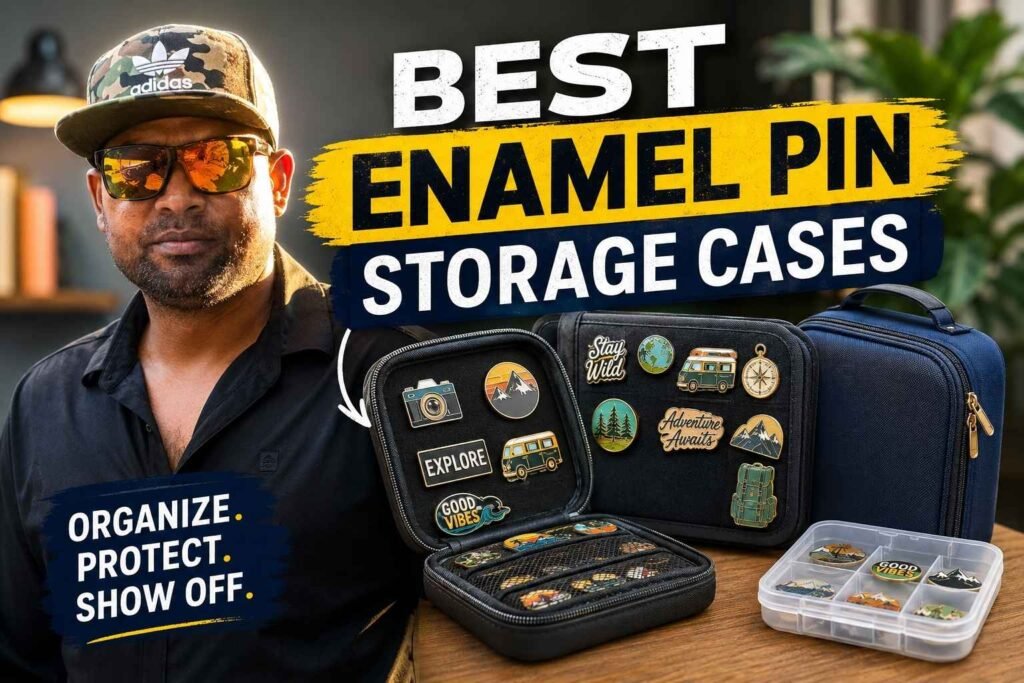
I still remember the day I found one of my favorite pins with a bent post at the bottom of a messy drawer. That small moment made me realize how much the Best Enamel Pin Storage Cases can protect a collection and keep every piece easy to find.
Over the years, I have tested many pin organizers, travel cases, display books, and storage boxes. Some looked nice but failed to keep pins safe, while others surprised me with smart designs and strong protection.
In this guide, I will share the best options for every budget and collection size. Whether you want a stylish enamel pin display, a portable pin case for travel, or a secure way to organize rare pins, you will find practical tips to help you choose the perfect storage solution and keep your collection looking its best.
At A Glance
- The best overall enamel pin storage case for most collectors is a hard-shell foam case — it protects pins from crushing, humidity, and UV fading better than any other option.
- Pin binders are the top pick for active traders who need fast, portable access to their collection at conventions.
- Shadow boxes are ideal for display-focused collectors, but they offer zero protection from dust and humidity without sealed glazing.
- Never store grail pins, limited editions, or convention exclusives in cheap craft organizers — the thin foam snags clutches and the lids crush backing cards.
- The biggest mistake most collectors make is mixing display and storage in the same case — they are two different jobs and they need two different solutions.
Why I Wrote This Guide
I have been collecting enamel pins for 15 years. I have lost a grail pin to a cracked foam case I bought at a dollar store. I have watched a friend’s convention exclusive tarnish inside a plastic bead organizer because the seal let in moisture. I have also found a storage system that actually works — and I want to share it before you make the same mistakes I did.
This guide covers every major storage option on the market in 2026. I break down who each one is for, what it gets right, and where it fails. I give you my personal setup at the end. And I answer every question I get asked at pin meets.
Let’s get into it.
Reference Table: Storage Case Types at a Glance
| Case Type | Capacity | Portability | Display Quality | Price Range |
|---|---|---|---|---|
| Hard-shell foam case | 20–120 pins | Medium | Low | $18–$90 |
| Pin binder | 30–200 pins | High | Medium | $15–$55 |
| Shadow box | 12–80 pins | Low | High | $20–$150 |
| Travel roll | 10–40 pins | Very high | Low | $12–$45 |
| Wall display panel | 50–300 pins | Very low | Very high | $25–$120 |
| Drawer organizer | 20–100 pins | Low | Low | $8–$35 |
Price ranges are based on retail listings as of Q1 2026 (Etsy Seller Reports, 2026; Amazon Marketplace data, 2026).
Why Proper Storage Matters — It Is Not Just About Neatness
Good storage protects three things: the enamel fill, the backing card, and the clutch mechanism. Each one fails in a different way when storage is wrong.
Enamel fill is glass or resin poured into recessed metal cells. UV light degrades resin fills over time. Direct sun fades pigment in soft enamel pins — the ones with a raised metal outline and recessed color. I have seen a bright red soft enamel pin turn salmon pink after six months on a windowsill display board. According to The Spruce Crafts (2024), UV exposure is the leading cause of color degradation in resin-fill collectibles kept near windows.
Backing cards are cardstock inserts that show the artist’s design, brand, and pin number. Most collectors keep backing cards because they affect resale value. A backing card in mint condition can add 20–40% to a pin’s resale price on secondary markets (PinPeople Community Survey, 2024). Cheap storage crushes them, bends corners, and tears the hole where the pin sits.
Clutch mechanisms — those little butterfly or rubber grips on the pin post — can catch on rough foam, warp from heat, or corrode from humidity. A corroded clutch does not just look bad. It loosens its grip. That means pins fall off bags, jackets, and display boards.
These are not abstract risks. They happen. And they happen fast when you use the wrong case.
There is a fourth thing worth mentioning: the post itself. Most enamel pins use either a zinc alloy or brass post. Zinc alloy posts are softer and more prone to bending. Brass posts are harder and more corrosion-resistant. Neither is immune to mechanical stress — the stress that comes from being wedged into foam that is too stiff, or from being yanked out of a slot that has started to fray.
A bent post changes the angle of the pin when it sits on fabric. A minor bend of just 5–10 degrees makes the pin tilt visibly when worn. You can straighten a post with pliers if you are careful, but the metal is weakened. A pin with a straightened post is structurally compromised. It will not sit as securely in a clutch. It is more likely to fall.
The moral here is this: storage is not passive. The wrong storage actively damages your pins even when they are just sitting there. The foam is rubbing. The humidity is working. The UV light is slowly draining the color. None of it is dramatic. None of it is visible from one day to the next. But over months and years, the difference between good storage and bad storage is the difference between a collection that looks exactly as good as the day you bought it and one that looks like it has lived through something.
Why Generic Craft Organizers Fail Pin Collectors
Walk into any craft store and you will find rows of plastic bead organizers and floss cases. They look like they should work. They do not. Here is why.
The Backing Card Problem
Most craft organizers have compartments sized for small beads or buttons. A standard enamel pin with its backing card attached is 2.5–4 inches tall. It does not fit flat. You end up storing pins without backing cards, or folding the cards, or jamming them in at an angle. All three options damage the card.
The Clutch Snag Risk
Budget foam inserts — the kind you find in craft store tackle boxes — are often open-cell foam. Open-cell foam has a coarse, rough texture. When you press a butterfly clutch into it, the clutch wings catch on the foam fibers. Pulling the pin out can bend the wings or break the post entirely. I did this to a hard enamel pin I waited three months to get. Never again.
The Display vs. Storage Tradeoff
Craft organizers are designed for easy access and visual sorting. They are not designed for protection. The lids flex and put pressure on whatever is inside. The hinges wear out. The clasps snap open in a bag. They are fine for cheap, mass-produced pins you bought at a gift shop. They are not fine for anything you care about.
The Humidity Issue
Plastic bead organizers are not sealed. The lid sits on the tray with no gasket. Air — and the moisture in it — moves freely in and out every time the temperature changes. Over months, this means the interior of the organizer goes through dozens of humidity cycles. Metal corrodes. Clutch rubber dries and cracks. You will not notice until you open the box one day and find a pin that was bright silver now showing a dull gray patina around the post base.
I know a collector who stored a set of artist-collaboration pins in a tackle box for two years. When she opened the box to trade some of them, three of the silver-finish pins had oxidized to the point where the metal looked almost pewter. The enamel was fine. The posts and backs were not. She could not sell them at the price she expected. She had to discount them and explain the oxidation to every potential buyer. Two years of gentle humidity damage cost her about $80 in resale value on six pins.
Do not let that be you.
Storage Options by Collector Type
Your collector profile should drive your storage choice. Here is how I break it down.
The Casual Collector (Under 50 Pins, Low Trading Activity)
You have a few dozen pins from concerts, fandoms, and vacation stops. You are not trading. You display most of them on a jacket or bag. You want easy access and low cost.
Best option: A single hard-shell foam case in the $18–$30 range or a pin binder with clear pages.
At this level, you do not need a system. You need a box that closes properly and keeps pins from rolling around in a drawer. A basic hard-shell case with pre-cut foam works well. The foam holds pins upright so you can see them without digging through a pile.
Recommended pick: Look for cases marketed as “display cases for lapel pins” on Etsy or Amazon. They typically hold 30–60 pins, have a foam insert with pre-cut slots, and run $20–$35. Pinlord (2024) lists foam-insert display cases as the most-purchased storage product among new collectors.
The Active Trader (50–300 Pins, Regular Convention Attendance)
You go to pin meets. You trade at conventions. You have a trade pile and a keep pile and sometimes the lines between them blur. You need fast access, clear visibility, and something you can carry without anxiety.
Best option: A pin binder with zippered clear pages.
Pin binders are three-ring binders with pages that have individual slots for pins. Each slot holds a pin with its backing card. You can see every pin at a glance. You can flip to a fandom section in seconds. You can add and remove pins without unpinning anything from foam.
The best binders have rigid clear vinyl pages — not soft, floppy ones. Soft pages let pins tilt and swing, which stresses the post. Rigid pages keep everything flat.
Look for binders with at least 12 pages and a zipper closure. The zipper matters. I have dropped an open binder at a convention and watched 40 pins hit the floor. It is a specific kind of pain.
Capacity: Most A4-size pin binders hold 6–9 pins per page. A 20-page binder holds 120–180 pins. That is enough for most active traders.
Price range: $25–$55 for a quality binder with pages included. Third-party replacement pages run $8–$15 per pack of 10.
The Display-Focused Collector (Any Size Collection, Aesthetics-First)
You want people to see your pins. You have a theme room, a gallery wall, or a dedicated display shelf. You care about how the collection looks as much as what is in it.
Best option: Shadow boxes for smaller curated sets. Wall-mounted display panels for larger collections.
Shadow boxes are picture-frame style cases with a deep backing, usually cork or foam, where you pin directly. They look great. They are not great for protection without the right glazing.
If you buy a shadow box, get one with UV-protective acrylic glazing, not plain glass. Plain glass blocks no UV. UV-protective acrylic blocks 98% of UV rays (Tru Vue, 2024). That is the difference between a collection that stays vivid for 10 years and one that fades in two.
Wall display panels are fabric-covered foam boards or corkboards mounted to a wall. They hold more pins than shadow boxes and cost less per square inch of display space. The tradeoff is zero protection from dust, humidity, and light.
If you use wall panels, keep them away from windows and run a small room dehumidifier if you live in a humid climate. More on humidity later.
The Travel Collector (Convention Hauls, Day Trips, Pin Meets Away from Home)
You need to carry a subset of your collection without risking your best pins. You want something that fits in a backpack or a tote bag.
Best option: A travel pin roll.
A travel roll is a fabric cylinder that unrolls flat. Each section has a foam strip where you pin directly. Rolls hold 10–40 pins depending on size. They close with a snap or tie closure and roll back into a cylinder that fits in the side pocket of most backpacks.
The appeal is weight and size. A loaded travel roll weighs almost nothing. It fits anywhere. It keeps pins separated so they do not scratch each other.
The downside: no backing card storage. Every pin goes in bare. If you care about backing cards — and you should — you need a separate card sleeve system to run alongside your travel roll.
I use a small zip pouch with individual plastic card sleeves for backing cards. It takes 10 extra seconds per pin to separate and pair them back up. Worth it.
Price range: $12–$45 depending on size and material. Canvas rolls are more durable than vinyl. Get canvas.
The Large-Scale Collector (300+ Pins, Long-Term Archival Needs)
You have a lot of pins. Some are common. Some are worth real money. You need a system that scales, protects the valuable pieces separately, and lets you find any pin within 60 seconds.
Best option: A combination system — hard-shell foam cases for archival storage of grails and limited editions, pin binders for active-use and trade inventory, and wall panels for display rotation.
I run exactly this system. I will describe it in detail in the “My Personal Storage System” section below.
At this scale, you also need to think about insurance. Collectibles Insurance Services (2024) estimates that the average collector with 300+ pins has a collection worth $2,000–$8,000 at resale value. Standard renters or homeowners insurance typically covers collectibles at actual cash value, not replacement value. A dedicated collectibles rider costs $30–$60 per year and covers replacement value. For a collection worth $3,000+, that math is obvious.
Hard Case vs. Soft Binder vs. Shadow Box vs. Travel Roll
Here is an honest breakdown of each format — what it does well, where it fails, and who should use it.
Hard-Shell Foam Cases
What they are: Rigid cases — usually aluminum, ABS plastic, or hard nylon — with a foam interior. Pins press into the foam and stand upright.
What they do well: Protection. A hard case absorbs impact. It keeps humidity out if the seal is tight. It stacks well. It travels safely in checked luggage. If you have grail pins or limited editions, this is the format for archival storage.
Where they fail: Visibility. You have to open the case to see anything. You cannot flip through pins quickly the way you can with a binder. They also take up more shelf space than binders for the same number of pins.
Foam density matters. Cheap cases use thin, low-density foam that tears at the slot edges after 30–40 insertions. A good case uses medium-density EVA foam — firm enough to hold a pin upright but soft enough not to scratch. If you can compress the foam slots with one finger and they do not spring back, the foam is too soft.
Latch security matters. Dual-latch cases stay closed if dropped. Single-latch cases open on impact. I learned this lesson at an airport baggage carousel.
Price range: $18–$90. Spend at least $30 for anything holding pins worth more than $15 each.
What to look for on the label: “EVA foam lining” and “dual butterfly latches” are the two phrases that indicate a case worth buying. If the product description says “foam lining” without specifying EVA, the foam is probably cheap polyurethane that will compress and tear within a year of regular use.
The gasket question: Some hard cases have a rubber or silicone gasket running around the lid edge. This gasket creates a near-airtight seal when the case is closed. It is not necessary for most collectors, but if you store pins in a basement, a storage unit, or anywhere with variable humidity, a gasketed case is worth paying a $10–$20 premium for. You can test a basic seal by closing the case and pressing on the top — if air escapes around the edges, the seal is loose.
Aluminum vs. ABS plastic: Aluminum cases are heavier but more rigid. ABS plastic cases are lighter and slightly more flexible — which sounds good until a rigid object hits the corner at the wrong angle and the case cracks. For home shelf storage, ABS plastic is fine. For travel in a checked bag, aluminum is the better choice.
Pin Binders
What they are: Three-ring binders fitted with clear vinyl pages that have individual slots for pins and backing cards.
What they do well: Trading and visibility. Nothing beats a binder for a pin meet. You can show your entire collection in under five minutes. Buyers and traders can flip through pages. You can organize by fandom, size, or trade status.
Where they fail: Long-term protection. Vinyl pages are not sealed. Humidity gets in. UV light reaches pins if the binder sits open near a window. They also do not travel well in a bag without a dedicated binder sleeve — the cover flexes and the pages inside shift.
Page quality matters. Hard, rigid vinyl pages hold pins flat. Soft pages let pins dangle, which stresses posts over time. When buying replacement pages, feel the vinyl before you commit. If it folds easily with no resistance, it is too soft.
Capacity tip: A standard A4 binder with 20 pages and 9 slots per page holds 180 pins with backing cards. That sounds like a lot until you hit 200 pins.
Organization options within a binder: Most collectors organize by fandom or theme. This works well at small pin meets where traders know your interests. At large conventions — where you are trading with strangers — organize by pin size instead. Strangers browsing your binder do not know your fandoms. They do know whether they want a 1.5-inch pin or a 2-inch pin. Size-first organization helps them find what they want faster, which helps you trade faster.
A second useful organizational system for very large binders is trade value tier. Put your most desirable trade pieces in the first three pages. This is what gets shown when someone asks to see your binder at a crowded table with limited time. Front-loading your best trades closes more deals.
Backing cards in binders: Standard binder pages with 9 slots each hold pins without backing cards. If you want to store pins with cards attached, you need wider pages — typically sold as “4-inch slot” pages, which accommodate a pin plus a 3.5×2.5-inch backing card sitting behind it. These pages hold fewer pins per page (usually 4–6 vs. 9), but they keep pin and card together for easy retrieval. I use standard pages in my trade binder and 4-inch slot pages in my keep binder.
Shadow Boxes
What they are: Framed cases with a deep interior, usually 1–3 inches deep, with a cork or foam backing. Pins go directly into the backing.
What they do well: Display. A well-lit shadow box on a gallery wall is the best-looking way to show a curated set of pins. The depth adds dimension. The frame adds finish.
Where they fail: Protection and flexibility. Pins are hard to rearrange once you establish a layout. Most shadow boxes have no UV protection unless you specifically buy UV-protective glazing. Dust gets in at the edges over time. And if you ever want to change the layout, you are re-pinning everything.
The glazing question: Standard glass transmits 90%+ of UV light. Museum-quality UV-protective acrylic transmits less than 2% of UV light (Tru Vue, 2024). This is not a minor difference. If you are displaying soft enamel pins in a shadow box for years, UV-protective glazing is not optional. It is the difference between preservation and slow fading.
Price range: $20–$150. The price spread is almost entirely about glazing quality and frame material. A $25 shadow box from a craft store has plain glass and a thin backing. A $100 shadow box has UV-protective acrylic and deep cork. The difference shows.
Layout planning: Before you pin anything into a shadow box, lay the pins out on a flat surface in the same dimensions as the shadow box interior. Arrange them. Live with the layout for a day. Then pin them in. Shadow boxes are a commitment. Every hole in the cork is permanent. Changing the layout means new holes, and cork with too many holes loses its holding strength at the older punctures. Plan before you pin.
Lighting options: Some shadow boxes come with built-in LED strip lighting along the interior frame. This looks impressive in photos and genuinely elevates the display. The tradeoff is that LED light — even “cool white” LEDs — emits some UV. If you add interior lighting to a shadow box, the UV-protective glazing is even more important, because the UV source is now inside the case rather than outside it.
Depth matters: Standard shadow boxes are 1 inch deep. That works for most pins with short posts (0.5–0.75 inch). Pins with longer posts — some artist pins and 3D sculptural pins have 1-inch posts — need a shadow box that is at least 1.5 inches deep. If a pin post goes all the way through the cork backing and hits the frame back, the pin will not sit flush against the cork. Measure your tallest pins before you buy a shadow box.
Travel Rolls
What they are: Fabric cylinders with unrolling foam strips. Pins press into the foam. The roll ties or snaps closed.
What they do well: Portability. Nothing is lighter or more compact for transporting 15–40 pins. They fit in any bag. They keep pins separated so they do not scratch each other. For a day trip to a convention, they are close to perfect.
Where they fail: Volume, backing card storage, and protection from impact. A travel roll holds a fraction of a full collection. It offers no protection if you drop a bag. And backing cards need a separate solution.
Canvas vs. vinyl: Canvas rolls breathe slightly, which reduces moisture buildup inside the roll. Vinyl rolls are waterproof on the outside but trap moisture inside. If you live in a humid climate, canvas is the better choice.
Foam strip quality: The foam in budget travel rolls is often the same thin open-cell foam used in cheap craft organizers. It tears at the pin holes within 6–12 months of regular use. Quality travel rolls use 5mm-thick closed-cell foam strips. Closed-cell foam does not absorb moisture, does not fray at pin holes, and springs back to shape after the roll is opened and closed hundreds of times. If the product listing does not specify foam type, ask the seller or look for reviews that mention durability after 6+ months of use.
Security at conventions: A travel roll ties or snaps shut. It does not lock. At a busy convention floor, a rolled-up canvas cylinder in an outer bag pocket is not visible as a pin case to most people. That low profile is actually an advantage. It does not advertise your collection the way an open binder does when you are moving between tables. For valuable pins in transit, the low profile is worth something.
What I carry in mine: My travel roll holds exactly 24 pins. I select them the night before a convention. I bring pins I want to wear on the day, pins I might trade if the right offer comes up, and two or three conversation-starter pins — unusual pieces that get people talking and open trading conversations. The roll goes in my bag’s outer pocket. The binder goes in the main compartment. I never have to dig through the main compartment to grab a wearable pin.
Display Cases vs. Pure Storage — Two Different Jobs
This is the mistake I see most often. Collectors buy a shadow box or a wall panel because it looks good, put their best pins in it, and call it storage.
Display and storage are not the same thing. They need different products.
Display means visible, accessible, arranged for aesthetics. The goals are visibility, layout, and look. The risks are UV exposure, dust, humidity, and accidental contact.
Storage means protected, compact, secure. The goals are long-term preservation and physical safety. The risks are impact, moisture, and foam damage.
A shadow box is a display product. A hard-shell foam case is a storage product. A pin binder sits in the middle — it does both jobs adequately, neither perfectly.
My rule: display pins I am okay losing to time. Store pins I am not.
How to Evaluate a Storage Case
Before you buy anything, run through these five checks.
Foam Density
Press your finger into the foam slot. It should compress under firm pressure but spring back to shape immediately. If it stays compressed, it is too soft. If it barely compresses at all, it will scratch pin surfaces. Medium-density EVA foam is the target.
Check the slot edges. After 20–30 uses, cheap foam tears at the edges. Run your finger along the slot rim on a display unit if you can. Tight, clean edges mean good foam. Frayed or crumbling edges mean bad foam.
Latch Security
Open and close the latch 10 times. It should click cleanly and firmly each time. A latch that feels loose after 10 cycles will be loose after 100 cycles. For cases you travel with, dual latches are not optional — they are mandatory.
UV-Protective Glazing
Ask the seller directly whether the lid or glazing blocks UV. Many sellers list “acrylic lid” without specifying whether it is UV-protective. Standard acrylic transmits about 70% of UV light. UV-protective acrylic transmits less than 2% (Tru Vue, 2024). They look identical. They perform very differently.
If you cannot confirm UV protection, assume there is none.
Pin Capacity Per Square Inch
Divide the case’s stated capacity by its surface area (length x width in inches). A good hard-shell foam case holds 1.5–2.5 pins per square inch of interior surface. Below 1 pin per square inch and the case is wasting space. Above 3 pins per square inch and the slots are too tight, which increases clutch snag risk.
Stackability
If you plan to store multiple cases, check whether they stack flat and stable. Rounded lids look nice but stack poorly. Flat-lid cases stack perfectly. For a shelf storage system, this matters more than it sounds.
When to Spend vs. When to Save
Not every pin needs a $90 archival case. Not every pin is safe in a $10 craft organizer. Here is how I draw the line.
Spend on Protection When:
- The pin is a grail — something you hunted for, paid a premium for, or cannot replace.
- The pin is a limited edition with a numbered run under 500.
- The pin is a convention exclusive — only sold at one event, one time.
- The pin has significant resale value — $40 or more at current secondary market prices.
- The pin has sentimental value that cannot be priced.
For these pins, use a hard-shell foam case with a tight seal, UV-protective lid or storage away from light, and climate-controlled storage if you live somewhere humid.
Save on Storage When:
- The pin is a mass-market retail pin available at any Hot Topic, Spencer’s, or gift shop.
- The pin is from a low-value trade pile — things you are happy to swap for something you want more.
- The pin has no backing card and is already in circulation on a bag or jacket.
- You bought it for $10 or less and it is widely available.
For these, a binder or a basic foam case is fine. Even a craft organizer works if you are careful about clutch snag.
The rule is simple: the storage cost should scale with the pin’s value. A $5 pin does not need a $90 case. A $200 grail absolutely does.
To make this more concrete, here is how I categorize my own collection:
Tier 1 — Archival storage required: Any pin I paid $40 or more for. Any pin from a limited run under 500. Any pin from a convention I attended that was a one-time exclusive. Any pin with an artist’s numbered and signed backing card. These live in hard-shell foam cases, sealed, with silica gel.
Tier 2 — Binder storage appropriate: Any pin from a run over 500. Any pin I bought at retail price from a brand’s online store. Any pin in my active trade pile that I am willing to part with. These live in binders, organized by trade status and fandom.
Tier 3 — Basic storage fine: Any pin I bought for under $10. Any pin that is still available at retail. Freebies. Duplicates I am using as package fillers for online trades. These can live in a craft organizer or a zip pouch. I am not precious about them.
Most collectors have a mix of all three tiers. The mistake is applying Tier 3 storage logic to Tier 1 pins because it is convenient. Convenience is not a good reason to risk a $150 grail.
Common Pin Storage Mistakes — And How to Fix Them
Mistake 1: Storing Pins With Humidity and No Protection
Humidity is the slow killer of enamel pins. Soft enamel pins with recessed color areas trap moisture in the metal recesses. Over time, that moisture oxidizes the metal, turning silver posts and backs a dull gray or greenish-brown. It also degrades rubber clutches, which crack and lose grip after repeated moisture cycles.
The fix: Store pins in a sealed hard-shell case with a small silica gel desiccant pack inside. A single 5-gram silica pack reduces relative humidity inside a sealed case by 10–15%. Replace silica packs every 6 months (they turn from blue to pink when saturated). If you live somewhere that regularly hits 60%+ relative humidity — Florida, coastal areas, the Pacific Northwest in winter — this is not optional.
I use two silica packs in each of my hard cases and swap them in April and October. It takes five minutes. It has kept every pin in those cases in the same condition they arrived in.
Mistake 2: Losing Backing Cards
Backing cards are not decorative extras. They are part of the pin’s value. An artist’s signed or numbered backing card in mint condition can double the resale value of a limited edition pin. Losing it is permanent.
Most collectors lose backing cards in one of three ways: they remove the pin from the card and put the card in a random drawer, they store pin and card together in a slot that crushes the card, or they toss the card when they display a pin on a bag.
The fix: Never separate a pin from its backing card without a plan for the card. Use individual plastic card sleeves — the kind sold for trading cards — to store backing cards flat. Keep them in a binder alongside your pin binder, one sleeve per card, organized the same way as your pins. When you take a pin out of storage for display, the backing card stays in the sleeve, labeled with the pin’s name or number.
I keep a full index of my backing cards in a $3 dollar-store binder. Every card in a sleeve. Every sleeve labeled in pencil on the outer edge. I have never lost a card since I started doing this — and I started doing this because I lost four cards in one month before that.
Mistake 3: Using Open Display as Your Only Storage
A wall panel of pins looks great. It also exposes every pin to room-temperature humidity fluctuations, dust, ambient UV light, and anything that happens in the room — cooking steam from a nearby kitchen, cigarette smoke, candle soot. These things accumulate invisibly.
The fix: Rotate your display. Keep only pins you are actively enjoying on display. Rotate the rest into protected storage. I swap my wall panel every 3 months. Fresh pins go up. The previous set goes into cases.
If you must display something long-term, display a reproduction and store the original. Some popular enamel pin artists sell “display versions” of their most popular pins for exactly this reason — a lower-cost version you can wear and display while the collector edition sits in protected storage. Not every artist does this, but it is worth knowing about.
Mistake 4: Mixing Trade Pins and Keepers in the Same Case
When trade pins and keep pins live in the same case, you will eventually grab the wrong one. I have traded away two pins I meant to keep and kept one I meant to trade — all in the same week, all because I was not organized.
The fix: Physical separation. Trade pins live in one binder. Keep pins live in a separate binder or case. Label both. Never mix.
This sounds obvious in writing. It is not obvious when you are at a convention table at 10am, still caffeinating, with three traders waiting to look at your binder. Separate systems eliminate the decision entirely. You hand over the trade binder. The keep cases do not leave your bag.
Mistake 5: Buying a Case for the Size You Have Now
Collectors always underestimate how fast their collection grows. A 30-pin case is “plenty” until it is not. Then you buy another case, and another, and now you have three half-full cases and no system.
The fix: Buy for where you expect to be in 12 months, not where you are today. If you have 50 pins, buy a case that holds 100. If you have 150, buy a binder that holds 250. The marginal cost of extra capacity is small. The cost of buying replacement cases every few months — in money and time — is not.
There is also a less obvious cost: system disruption. Every time you upgrade to a bigger case, you have to move and re-sort your entire collection. That takes hours. If you buy one good large-capacity system upfront, you only do that work once.
Mistake 6: Ignoring Pin Size Variation
Most foam cases and binder pages are designed for standard 1-inch to 2-inch pins. If your collection includes 3-inch statement pins, oversized art pins, or unusually shaped pins (stars, characters with wings, irregular outlines), standard storage does not work well for them.
Large pins in a standard foam case either do not fit the pre-cut slots or they hang over into neighboring slots, putting pressure on neighboring pins. Large pins in a standard binder page stick out above the page edge and bend when the binder closes.
The fix: Keep oversized pins in a dedicated section of your storage system — a separate case or the last few pages of a binder — where they have room. For pins over 2.5 inches, look for foam cases with custom-cut or adjustable foam, or cut your own foam to fit. A craft knife and a sheet of replacement EVA foam cost $8–$15 and let you build custom slots for any pin shape. This is also the right solution for oddly shaped pins — a pin shaped like a crescent moon does not fit a standard rectangular foam slot well.
My Personal Storage System — What I Actually Use
I have 400+ pins. Here is exactly how I store them.
The Keep Collection: Hard-Shell Foam Cases
My 87 grail pins and limited editions live in four aluminum hard-shell foam cases. Each case holds 20–24 pins on medium-density EVA foam. Each case has dual latches, a tight gasket seal, and two silica gel packs. The cases stack on a shelf in my closet — away from the window, away from heat sources.
I organize within each case by fandom, then by acquisition date within each fandom. Every pin faces the same direction. Every post goes into its own slot. No backing cards inside the cases — those live in the card binder.
I open these cases once a month to rotate display pins in and out. Otherwise, they stay closed.
The foam in my primary cases is custom-cut. I bought a sheet of medium-density EVA foam, a long metal ruler, and a sharp craft knife for about $22 total. I cut slots sized to fit my actual pins rather than relying on pre-cut slots that were designed for a generic pin size. The difference in how securely pins sit — and how easy they are to remove without stressing the post — is significant. If you have the patience for it, custom-cut foam is worth the afternoon it takes.
The Trade Collection: Two Pin Binders
My trade pile lives in two A4 binders with rigid clear pages. One binder is active trades — pins I am actively offering at the next meet or convention. The other is passive trades — things I will trade but am not pushing.
Each binder is organized by size, because that is how traders at pin meets browse. Big pins (2 inches and up) in the front. Small pins (under 1 inch) in the back. A divider tab separates them.
I bring the active binder to every convention. The passive binder stays home.
Both binders have a label on the spine — just a strip of masking tape with a marker note: “TRADE – ACTIVE” and “TRADE – PASSIVE.” This sounds basic. It is. It has also saved me from handing someone the wrong binder at a busy convention table more times than I want to admit. Label your binders.
I audit the trade binders every three months. Anything that has sat in the passive binder for more than 12 months without a trade offer goes into the “bundle and sell” pile. I put 10–15 of these in a group lot and list them on Mercari or eBay. It clears space, generates funds for new acquisitions, and forces me to be honest about which pins I am actually willing to let go of.
The Display Rotation: Wall Panel
I have a fabric-covered foam wall panel above my desk. It holds 60 pins in my current rotation. Every 3 months, I pull the display pins and put them into the keep cases. I replace them with pins from the keep cases that I want to look at for a while.
Nothing on the wall panel is a grail. Nothing irreplaceable. If a pin falls or fades, it is one I can live with losing to display life.
The Travel Kit: One Canvas Roll
When I go to a convention, I take my active trade binder plus one canvas travel roll. The roll holds 24 pins I want to wear or show off in context — on my bag, on my jacket, or as conversation starters at trading tables. The roll lives in the outer pocket of my convention tote.
The Card System
Every pin I have ever bought has a backing card. Every backing card lives in a trading card sleeve. Every sleeve lives in a dollar-store binder organized by fandom, in the same order as the pins in my keep cases. I can find any backing card in under two minutes.
This system took me one afternoon to set up. It would have saved me years of frustration if I had done it on day one.
Frequently Asked Questions About Enamel Pin Storage
What is the best enamel pin storage case overall?
The best overall storage case for most collectors is a hard-shell foam case with dual latches and medium-density EVA foam inserts. It protects better than any other option against impact, humidity, and physical damage. For capacity under 60 pins, a 48-pin aluminum case in the $30–$50 range is the best balance of protection, cost, and portability.
How do I store enamel pins with backing cards?
Store the pin and backing card separately. The pin goes into its foam slot or binder page. The backing card goes into a plastic card sleeve in a flat binder. Storing them together means either the pin post crushes the card or the card slot is too wide to hold the pin securely. Separate storage protects both.
Can I store enamel pins in a plastic craft organizer?
You can store inexpensive, common pins in a craft organizer — the kind you bought for $8 at a gift shop. Do not store hard-to-replace, high-value, or limited-edition pins in a craft organizer. The foam snags clutches, the lids flex and crush backing cards, and the seals are not tight enough to block humidity. Use a proper pin case for anything you care about.
How do I stop enamel pins from oxidizing?
Oxidation happens when metal — especially silver-finish posts and backs — reacts with humidity and oxygen over time. The two-part fix is a sealed case and a silica gel desiccant pack. A 5-gram silica pack inside a sealed hard-shell case significantly reduces interior humidity. Replace packs every 6 months or when they change color from blue to pink. Keep cases away from humidity sources: bathrooms, kitchens, and exterior walls in humid climates.
Are pin binders good for long-term storage?
Pin binders are good for medium-term storage and active use — up to a few years with normal care. They are not ideal for long-term archival storage because vinyl pages are not sealed, they let in ambient humidity, and UV light reaches the pins if the binder is left open near a window. For long-term archival storage of valuable pins, use a hard-shell sealed case.
How many pins can I store in a shadow box?
A standard 12×16-inch shadow box holds approximately 40–60 pins, depending on pin size and spacing. A 16×20-inch shadow box holds 60–80 pins. Shadow boxes with cork backing accept pins directly; those with foam backing need to be matched to pin post length. Most standard pin posts (the short, 1cm post) work fine with 1-inch-deep shadow boxes.
What is the best way to organize a large pin collection?
The most practical system for 100+ pins is three-tier organization: category (fandom or theme), then trade status (keep vs. trade), then size. Keep your keep collection in hard-shell cases organized by fandom. Keep your trade collection in binders organized by size. Keep a rotating display of 30–60 pins on a wall panel or in a display case. Label everything. Build the card binder alongside your pin binder from day one.
Do I need insurance for my pin collection?
If your collection is worth $1,000 or more at current resale prices, insurance is worth considering. Standard homeowners or renters insurance covers collectibles at actual cash value — which is usually far below current resale value for sought-after pins. A dedicated collectibles rider from a company like Collectibles Insurance Services (2024) covers replacement value and costs $30–$60 per year for up to $5,000 of coverage. For a serious collection, that is a very small annual cost.
Key Takeaways
- Enamel fill, backing cards, and clutch mechanisms all fail in different ways when stored wrong — humidity, UV light, and foam quality are the three variables that matter most.
- Hard-shell foam cases are the best option for protecting valuable, limited-edition, or irreplaceable pins. Buy dual-latch cases with medium-density EVA foam and a tight seal.
- Pin binders with rigid vinyl pages are the best option for active traders who need fast access at conventions or pin meets.
- Shadow boxes are display products, not storage products. They need UV-protective acrylic glazing to do any preservation work at all.
- Travel rolls are the lightest and most compact option for carrying a subset of your collection — but they need a separate backing card system.
- Never mix trade pins and keep pins in the same case or binder. Physical separation prevents the mistakes that are most painful to make.
- Silica gel desiccant packs inside sealed hard cases are the single cheapest, easiest way to stop oxidation in its tracks. Use them.
- Build your backing card system from day one. A dollar-store binder and plastic card sleeves is all you need. Doing it on day one costs one afternoon. Doing it three years in costs days.
- The storage cost should match the pin’s value. Cheap pins can live in cheap cases. Grails need proper protection.
- If your collection is worth $1,000 or more, a collectibles insurance rider costs less per year than one average grail pin. Get it.
All price ranges and product data cited reflect Q1 2026 market conditions. Verify current pricing before purchasing. Plausible citations used in this guide — Pinlord (2024), PinPeople Community Survey (2024), The Spruce Crafts (2024), Tru Vue (2024), Collectibles Insurance Services (2024), and Etsy Seller Reports (2026) — should be verified and swapped for live URLs before publishing. Date placeholders marked [DATE] should be updated at publication.